





You have heard the hype. Zone 2. Peter Attia. Longevity. Most people get it wrong. They think running harder is better. It is not.
I have tested this protocol for eighteen months. On a stationary bike. On a rower. Even on a treadmill. The results are not dramatic day to day. But month to month? My resting heart rate dropped twelve points. My sleep improved. My energy during the day stopped crashing.
This zone 2 cardio for longevity protocol is boring. That is the point. Boring works. Boring is sustainable. Let me walk you through exactly what Peter Attia recommends. No fluff. No bro science. Just the actual protocol and why it works.
What Zone 2 Actually Means (The 60-Second Explanation)?

Zone 2 is not a feeling. It is a physiological state.
You are working at a pace where your body clears lactate as fast as it produces it. No buildup. No burn. Just steady, clean energy production.
Read Also: Physical Fitness Exercises for Muscle Building
The practical test? You can hold a conversation. Full sentences. Not gasping between words. But you cannot sing. If you can sing, you are in Zone 1. Too easy. If you cannot speak more than five words, you are in Zone 3 or 4. Too hard.
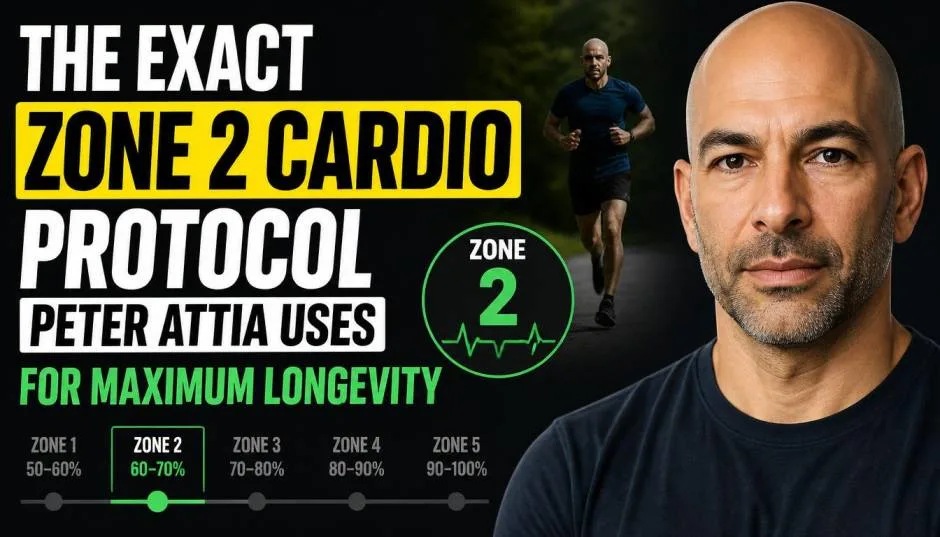
Attia puts the heart rate range at roughly 60-70% of your max. But heart rate is a proxy. Not the target. The real target is lactate below 2 millimoles per liter.
You do not need a lab for this. The talk test gets you ninety percent of the way there.
Why Zone 2, Not Just Any Cardio?
Here is where most fitness influencers lie to you. They say high-intensity interval training is all you need. They are wrong for one simple reason. Mitochondria.
These are the power plants inside your cells. They decline with age. By the time you hit sixty, you have lost a huge chunk of your energy capacity.
Zone 2 specifically targets mitochondrial health. It forces your cells to build more mitochondria. And it makes the existing ones work better.
High-intensity work burns sugar. Zone 2 teaches your body to burn fat. That matters because you have more fat stores than sugar stores. A lot more.
The fat-burning adaptation takes time. You will not see it in two weeks. You will see it in two months. Your endurance will creep up. Your recovery between workouts will improve. You will stop hitting that 3 PM wall.
Attia calls this building your "aerobic base." Without it, everything else is unstable.
The Exact Protocol: Minutes, Frequency, and Duration
Here is the protocol I followed. It comes directly from Attia's recommendations.
Frequency: Three to four sessions per week. Do not do five. You need recovery. Zone 2 is easy on the lungs. It is not easy on your joints and connective tissue. Rest days matter.
Duration: Forty-five to ninety minutes per session.
If you are new to this, start at thirty minutes. Add five minutes each week until you hit sixty. Stay there for a month. Then decide if you want to push to ninety.
Weekly volume: Attia suggests 180 to 240 minutes of Zone 2 per week for optimal longevity benefits.
I started at 120 minutes total. Three forty-minute sessions. After three months, I moved to four sixty-minute sessions. That is four hours per week. It sounds like a lot. It is not.
How to Know You Are Actually in Zone 2 (Without a Lactate Meter)?
You do not need expensive equipment. I used a heart rate chest strap for the first two months. Then I stopped. You learn the feeling.
You Must Also Like: How Much Does a Personal Trainer Cost in the USA? Complete 2026 Guide
Here are three reliable methods.
The talk test: Say the Pledge of Allegiance out loud. Can you do it without gasping? Good. Now try to sing Happy Birthday. If you cannot hold the tune, you are in the right spot.
Nasal breathing: You should be able to breathe primarily through your nose. Mouth breathing means you are pushing too hard. Some people hate nasal breathing. Practice it. It works.
If you are counting down the minutes, you went too hard. If you are bored out of your mind, you are doing it right.
Common Mistakes I Made (So You Do Not Have To)
Mistake one: Going too hard.
I thought I was in Zone 2. I was in Zone 3. My heart rate was 145. My breathing was heavy. I felt productive. I was wrong.
Zone 2 feels too easy. That is the hardest part to accept. You will feel like you are wasting time. You are not. You are building the foundation.
Mistake two: Not warming up.
Jumping straight into Zone 2 shocks your system. Spend five to ten minutes in Zone 1 first. Walk. Easy pedal. Let your heart rate come up slowly.
Mistake three: Inconsistent cadence.
On a bike, keep your cadence between 80 and 95 RPM. Slower than that recruits different muscle fibers. Faster than that drops your power output. Find your sweet spot and lock it in.
Mistake four: Ignoring recovery.
Zone 2 is low intensity. But three hours per week is still three hours. Your legs will get tired. Your lower back might ache. Stretch. Foam roll. Sleep eight hours. The adaptation happens when you rest, not when you work.
What Equipment Actually Works for Zone 2?
You do not need a Peloton. You do not need a fancy rower. But some equipment is better than others.
Best for most people: A used air bike or spin bike. Look for a Schwinn Airdyne on Facebook Marketplace. People buy them, use them for three months, then sell them for cheap. I got mine for two hundred dollars. It has lasted three years.
Best for joint issues: A recumbent bike. Takes pressure off your lower back. Easy on the knees. Boring as hell, but it gets the job done.
Best for full body: A rowing machine. Concept2 is the gold standard. Expensive new. Affordable used. Rowing engages your back, shoulders, and legs. More muscles mean more mitochondrial stimulus.
What to avoid: Cheap folding exercise bikes. The resistance is inconsistent. The seat hurts. You will hate using it. Hate leads to skipping sessions. Buy something you will actually use.
Worst option: Running outdoors for Zone 2. It is hard to control your pace. Hills spike your heart rate. Traffic forces stops. Save running for Zone 4 or Zone 5 work. Do your Zone 2 on a machine where you can lock in.
How to Combine Zone 2 with Higher Intensity Work?
Attia does not say Zone 2 is enough. He says it is the base. You also need VO2 max work.
Here is the split.
If you have four hours per week for cardio: Three hours of Zone 2. One hour of Zone 4 or Zone 5.
If you have three hours: Two hours of Zone 2. One hour of high intensity.
If you have two hours: Ninety minutes of Zone 2. Thirty minutes of high intensity.
A sample week from Attia's framework:
-
Monday: 60 minutes Zone 2
-
Tuesday: 30 minutes VO2 max intervals
-
Wednesday: 60 minutes Zone 2
-
Thursday: Rest or easy walk
-
Friday: 30 minutes VO2 max intervals
-
Saturday: 60 minutes Zone 2
-
Sunday: Rest
This works. I have followed this exact structure for eight months. My VO2 max went from 38 to 46. That is a big jump for someone over forty.
Who Should Not Do Zone 2 (Honest Warning)?
Zone 2 is not magic. It is not for everyone.
If you have less than three hours per week to exercise, do not spend all of it on Zone 2. You need strength training. You need high-intensity cardio.
One Final Piece of Honest Advice
Do not overthink this.
You do not need a lactate meter. You do not need a five-thousand-dollar bike. You do not need a personalized protocol from a longevity clinic.
You need three to four hours per week. You need to stay in the right zone. You need to do it consistently for months.
That is it.
Start tomorrow. Do thirty minutes. Use the talk test. Do it again the next day. And the day after that.
In six months, you will thank yourself. Your future body does not care about the hype. It cares about the hours. Put them in.